Showing all 6 resultsSorted by popularity
Marimo Moss Ball Aquarium – Aegagropila linnaei 3–4 cm
Price range: 16.00 $ through 763.20 $ Exc. TaxMarimo Moss Ball – Aegagropila linnaei 2–3 cm
Price range: 0.00 $ through 619.20 $ Exc. TaxMoss ball Aquarium – Marimo Ball 1–2 cm
Price range: 0.00 $ through 460.80 $ Exc. TaxXXL Marimo Moss Balls 7-10 cm
Price range: 20.80 $ through 720.00 $ Exc. TaxMarimo Moss Balls for Aquarium 5–7 cm
Price range: 19.20 $ through 288.00 $ Exc. TaxMarimo Moss Ball – Aquarium Moss Ball 4–5 cm
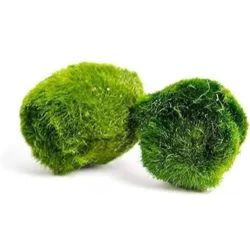
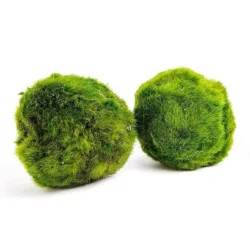
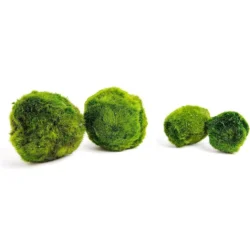
Price range: 17.60 $ through 1080.00 $ Exc. TaxMarimo moss balls are living spheres of green alga that sit on the floor of an aquarium. They are not moss, not a plant in the usual sense, and not decorations — they are a colony of Aegagropila linnaei, a filamentous alga that grows into a dense ball because slow currents roll it around the lake bed for years.
Marimo moss balls are also about as close to maintenance-free as a living aquarium inhabitant gets, which is why they end up in first tanks and in the tanks of people who have kept fish for thirty years.
Where Marimo Moss Balls Come From
Marimo moss balls occur naturally in only a few cold northern lakes. Lake Akan in Hokkaido is the best known — the Japanese name means roughly “ball seaweed” — with other populations in Iceland and Estonia.
In the wild the shape of a marimo moss ball comes from the environment rather than from the organism. Gentle currents turn the ball continuously, so every side gets light and grows at a similar rate. Left undisturbed, an alga colony would grow as an irregular mat; it is the rolling that makes a sphere.
Growth is slow — a few millimetres a year — so a large specimen represents a considerable amount of time.
Sizes We Offer
| Size | Suits |
|---|---|
| 1–2 cm | Nano tanks, jars, shrimp setups; often bought in groups |
| 2–3 cm | Small aquariums; the most popular starting size |
| 3–4 cm | Standard community tanks |
| 4–5 cm | Larger tanks, where a smaller ball would be lost |
| 5–7 cm | Feature specimens |
| 7–10 cm (XXL) | Statement pieces; decades of growth in one sphere |
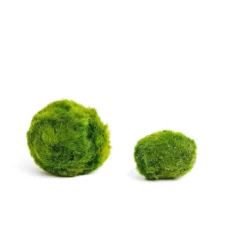
Scale the marimo moss ball to the tank. Several small spheres grouped together generally look better than one medium one, and they rearrange themselves over time as you clean around them.
What Marimo Moss Balls Do for an Aquarium
- Absorb nitrate and phosphate as they photosynthesise. A genuine contribution to water quality, and not a substitute for filtration or water changes.
- Release oxygen in light. On a bright day a healthy ball produces small bubbles that cling to its surface, and sometimes enough to float it — which is a good sign rather than a problem.
- Provide grazing. Shrimp work the surface constantly for biofilm, which is one of the more entertaining things to watch in a small tank.
- Give shelter. Fry and shrimplets hide among them.
- Do not compete. They grow too slowly to outcompete other plants or take over a tank.
Marimo Moss Balls With Betta and Shrimp
Marimo moss balls pair well with both, and both are common.
Betta tanks are often small, sparsely planted and low-light, which suits Marimo exactly. Bettas sometimes rest on them or push them around, neither of which does any harm.
Shrimp tanks are where they earn their place. The surface accumulates biofilm continuously and shrimp graze it all day. In a colony tank you will regularly see several shrimp working over one ball.
They are safe with everything. There is nothing toxic, nothing sharp, and no fish that has a problem with them.
Care Guide
- Water changes. Whatever schedule your tank already runs on. They need no separate treatment.
- Keep it cool. Below about 24°C (75°F) is comfortable. Sustained warmth is the main cause of a ball breaking down, which is why they struggle in unheated tropical tanks in hot rooms.
- Low light. They evolved on lake beds. Bright aquarium lighting encourages algae to grow on them, which is a nuisance to clean off.
- Roll them occasionally. Every water change, squeeze gently under tank water and roll between your palms. This keeps the shape even and stops the underside flattening and browning.
- Turn them over now and then if you never roll them, so the same side is not always in shadow.
A ball that goes brown on one side has usually been sitting undisturbed in one position. Roll it, and the affected side generally recovers over weeks.
Common Problems and Fixes
Brown patches — nearly always the shaded underside. Roll regularly.
Falling apart — usually heat, sometimes age. Loose pieces can be rolled back into smaller balls by hand and will hold their shape.
Floating — normal, and a sign of active photosynthesis; trapped oxygen lifts it. It sinks again when the bubbles release.
Algae growing on it — too much light. Reduce the lighting period and brush the surface gently.
Marimo Moss Balls: Frequently Asked Questions
Are Marimo moss balls actually moss?
No. They are colonies of green alga, Aegagropila linnaei. The name is common usage, not botany.
Are they alive?
Yes, fully living and photosynthesising.
How big do they get?
A few millimetres a year. The largest wild specimens reach 20–30 cm after many decades.
How long do they live?
Decades in stable conditions. In Japan some documented specimens are over a century old.
Do they clean the water?
They absorb some nitrate and phosphate. Helpful, but not a filter.
Can they live in tap water?
Use dechlorinated water, as you would for any tank.
Can I keep one in a jar without a filter?
Yes — that is a common setup. Change the water every one to two weeks and keep it out of direct sun.
Why is mine floating?
Oxygen bubbles from photosynthesis. It means the ball is healthy.
Related Collections
For spheres made from preserved plants that need no water at all, see decorative moss balls. Both types are listed under moss balls.