



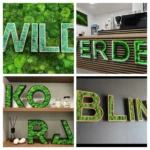






Showing the single result
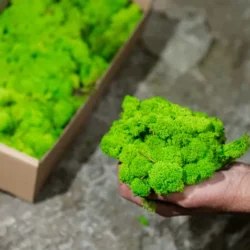
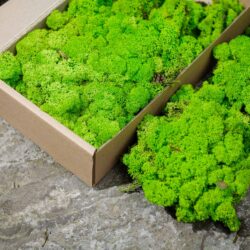
Preserved Island Moss | Wall Moss and Moss Art 5kg
Price range: 172.80 $ through 259.20 $ Exc. TaxThis is the raw material rather than a finished piece: preserved moss sold by the box, for people building their own walls, frames, terrariums and floral work. Same material we use in the workshop, same batches, without the assembly.
If you have worked with dried florals rather than preserved moss before, the difference is worth understanding up front. Dried material is brittle and crumbles under handling. Preserved material stays soft and flexible for years, because the process replaces what was lost rather than simply removing water.
What Preserved Moss Actually Is
Harvested moss is soaked in a plant-based glycerin solution to become preserved moss. The glycerin displaces the sap in the cell walls and stays there, holding the tissue soft and pliable. Colour is stabilised at the same time, either keeping the natural tone or taking a dye.
The result is material that stopped being alive but did not become brittle. It will not grow, will not rot, and does not need water or light. It also will not tolerate being watered — that is the mistake people make once, and only once, because water washes glycerin out and the material hardens.
You will see “stabilized moss” used for the same thing, particularly by European suppliers. The terms are interchangeable.
The Types We Supply
| Type | Texture | Typical use |
|---|---|---|
| Reindeer lichen | Springy, branching, holds its shape under pressure | Wall panels, frames, terrariums, floral fill — the most versatile of the range |
| Sheet / flat | Carpet-like mats with a soil-free backing | Covering large areas quickly; base layer under other species |
| Bun | Dense domed mounds, strong relief | Feature areas and 3D compositions where depth matters |
| Provence | Fine, matted, silvery-green | Muted palettes; blending between darker and lighter areas |
| Fern moss | Feathery, fine-branched | Detail work and filling gaps between larger clumps |
Buying Preserved Moss in Bulk
Most preserved moss orders here are quantity orders. A single frame takes very little; a wall takes considerably more than people estimate, and running out halfway through a project is a genuine problem because dye batches vary slightly.
Two practical rules for ordering preserved moss. First, calculate your area and add roughly 15% — clumps have irregular edges and you will trim waste at every join. Second, order the whole project in one go rather than topping up later. Natural variation between batches is small but visible when two of them meet on the same wall.
For trade and repeat orders, ask about wholesale terms rather than ordering box by box.
What People Build With Preserved Moss
- Wall panels and green walls — the largest-volume use, and where sheet material earns its keep.
- Framed pieces — reindeer lichen and bun species, layered for depth inside a deep frame.
- Terrariums and vivariums — decorative use only; preserved material is not a substrate and will not support living plants.
- Floral and event work — table runners, arch bases, centerpiece fill that survives transport and the whole weekend.
- Retail displays and props — window schemes and photo backdrops that get packed, moved and reused.
- Model making and craft — architectural models, dioramas, school projects.
Working With It
- Unpack and let it breathe for an hour. Material compresses in transit and recovers loft on its own.
- Sort by tone before you start gluing. Natural variation within a box is normal, and distributing it deliberately looks far better than discovering it halfway through.
- Use hot glue on a low setting, or a solvent-free craft adhesive. High heat scorches the fibres.
- Work from the edges of your surface inward, so joins land in the middle where they are easiest to hide.
- Press clumps together tightly. Gaps that look minor while you work read as bald patches once the piece is on a wall and lit from above.
Gloves are optional. Some people find glycerin-treated material leaves a slight residue on the hands; it washes off with soap.
Storage and Lifespan
Sealed in its packaging and kept indoors, unused preserved moss stays workable for years. Store it dry and out of the sun, in a box rather than a bag, and do not stack heavy things on it — pressure marks in compressed material do not always recover.
Finished work made from it holds up for 7 to 10 years indoors. Direct sunlight fades colour, damp softens the structure over time, and handling wears the surface. Nothing else is required of it.
Preserved Moss: Frequently Asked Questions
Is preserved moss alive?
No. It grew, it was harvested, and preservation stopped the biology. It will not grow, spread or die.
Does it need watering or misting?
No — and misting actively harms it. Water washes out the glycerin and leaves the material hard and brittle.
What is the difference between preserved and dried?
Dried material has had its moisture removed and is brittle. Preserved material has had its sap replaced with glycerin and stays soft. For anything that will be handled or seen up close, preserved is the one you want.
Can I use it in a terrarium with live plants?
As decoration, yes. As a growing medium, no — it holds no nutrients, and the humidity of a closed planted terrarium will eventually degrade it.
Is it safe around pets and children?
The material is natural and non-toxic. It is not food, and loose fibres are a choking risk for very small children, so keep bulk stock out of reach.
How much do I need for a wall?
Measure the area, subtract obstacles, add about 15% for trimming waste.
Will the colour match between orders?
Close, but not identical. Natural material dyed in batches carries slight variation, so order everything for one project together.
Related Collections
If you would rather buy the finished result than build it, moss wall panels arrive ready to hang. Empty frames built with the right depth for filling are under frames for moss wall art, and complete kits with material, frame and instructions are in DIY moss crafts.