Showing all 8 resultsSorted by popularity
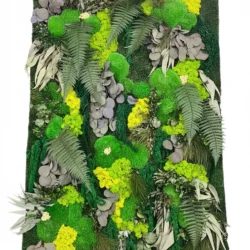
Moss Panel with Cushion Moss and Flat Moss 20/80
Price range: 64.00 $ through 720.00 $ Exc. TaxMoss Panel with Cushion Moss and Sheet Moss 50/50
Price range: 78.40 $ through 907.20 $ Exc. TaxMoss Panel with Sheet Moss
Price range: 64.00 $ through 792.00 $ Exc. TaxPlant Wall Panels: Jungle Moss Panel
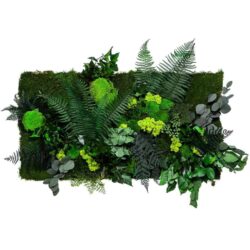
Price range: 100.80 $ through 979.20 $ Exc. TaxPlant Wall Panels – Moss Panel with Plants
Price range: 144.00 $ through 835.20 $ Exc. TaxMoss Panel with Provence Moss
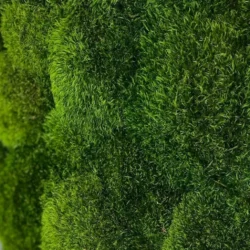
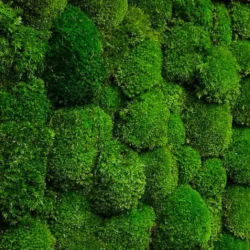
Price range: 72.00 $ through 691.20 $ Exc. TaxMoss Panel with Ball Moss
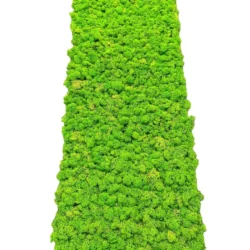
Price range: 78.40 $ through 720.00 $ Exc. TaxMoss Panel with Preserved Reindeer Moss
Price range: 72.00 $ through 345.60 $ Exc. TaxA moss wall panel is a section of preserved moss mounted on a rigid backing board. You hang it like a picture, except it covers a surface rather than a spot on it. Our moss wall panels are built to order in sizes that tile together, so one panel above a desk and a full wall behind a reception counter are the same product at different scale.
The moss is real. It grew, it was harvested, and its sap was replaced with a plant-based glycerin solution that keeps the cell structure soft and the colour stable. What it no longer does is grow, drink or need light. That is the point: you get the surface of a living wall without irrigation lines, grow lights, drainage or a service contract.
What Is a Preserved Moss Wall?
Before choosing moss wall panels it helps to know that interior greenery splits into three categories, and the difference matters before you spend anything.
A living wall is a hydroponic system with plants rooted in it. It needs plumbing, lighting, feeding and someone to service it every few weeks. An artificial green wall is plastic. It photographs well and reads as fake the moment anyone gets within arm’s reach, because plastic has no depth of colour and no variation between one leaf and the next.
A preserved moss wall sits between the two, and much closer to the first. Every fibre is botanical material that once grew, which is why the colour shifts subtly across a panel and why the texture holds up under close inspection. Preservation stops the biology; it does not replace the material. In an office where people walk past the surface daily, that difference registers with them even when they cannot name it.
How Our Moss Wall Panels Are Made
Each moss wall panel is assembled by hand in our workshop. The moss is sorted by tone and density, trimmed, and set into the backing so the seams between clumps disappear. Where a design mixes two species, the proportions are fixed rather than improvised: our cushion-and-flat version runs at 20/80, the cushion-and-sheet version at 50/50. Those ratios hold their visual balance when a panel is repeated across a wall, which random mixing does not.
The backing of each moss wall panel is a rigid board cut to size, with the surface worked right out to the edge. Panels butt together without a visible frame line, and that is what lets several of them read as one continuous wall instead of a grid of separate pictures. A single decorative piece can be framed instead, if you want it to sit as an object rather than as cladding.
Moss Types and Textures for Wall Panels
The moss you choose changes the depth of the surface far more than the colour does. The practical differences:
| Type | Surface | Depth | Best for |
|---|---|---|---|
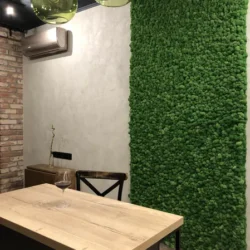
| Reindeer lichen | Springy, branching, coral-like | Medium, even | Large uniform areas; the most forgiving over long runs |
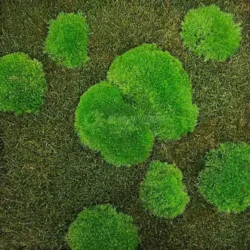
| Bun | Domed mounds with visible gaps | High, sculptural | Feature sections where you want relief and shadow |
| Flat / sheet | Dense, low, carpet-like | Low, flat | Calm backgrounds; base layer under other species |
| Provence | Fine, matted, silvery-green | Low to medium | Muted palettes and softer contrast |
| Mixed | Two or three species in set ratios | Varied | Walls that need movement rather than one flat tone |
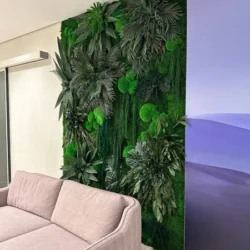
Versions with preserved plants worked in — ferns, grasses, dried stems — read as denser and more jungle-like. Those photograph best in restaurants and lobbies, where the wall is seen from several metres away and needs silhouette, not just texture.
Acoustics and Sound Absorption
Moss is porous and irregular, and porous irregular surfaces absorb sound instead of bouncing it back. In a room with hard floors, glass and plasterboard, moss acoustic panels take the edge off the reverberation that makes open-plan offices tiring by mid-afternoon.
Be realistic about the scale of the effect. One piece over a desk changes the acoustics of that desk. Meaningful absorption across a room needs meaningful coverage — a full wall, or a divider standing where sound actually travels. If acoustics are the main reason you are buying, tell us when you order and we will specify accordingly.
Where Preserved Moss Walls Are Used
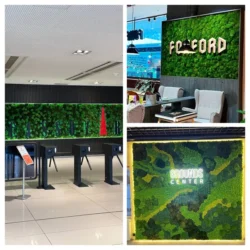
- Offices — behind reception, along corridors, in meeting rooms where video calls pick up echo.
- Restaurants and cafés — the surface survives daily service, because there is nothing to water and no leaves to drop into food.
- Retail — fitting-room walls and product backdrops, where green reads as natural without occupying floor space.
- Clinics, salons and studios — rooms where people wait, and where a quiet surface does more than a poster.
- Homes — behind a bed, along a stairwell, or in a home office that appears on camera all day.
Rented premises are a common case for moss wall panels. Panels come down as easily as they go up and take nothing with them but the fixings, so the wall is worth doing even on a three-year lease.
Sizes, Coverage and Custom Projects
Every moss wall panel is made to order, so the question is not which size we stock but how much surface you need covered. Measure the area, subtract sockets, switches and anything already mounted, and work from that figure. It is normal for a project to combine a few large pieces with several smaller ones cut to fit around obstacles.
For a coherent result across a large preserved moss wall, keep the species and the mix ratio identical throughout and let the natural variation do the rest. Switching species mid-wall reads as a mistake unless the change lands on a deliberate line.
If the wall is meant to carry a company name or a logo, that is a related but separate build — see moss letters and logos, where lettering is cut and covered as its own element, then mounted onto or beside the panelled surface.
Installation, Step by Step
- Check the wall is dry and sound. Fresh plaster needs to cure first; a damp wall needs fixing before anything goes on it.
- Mark a level line for the top row. Everything that follows takes its position from that line, so it is worth the extra five minutes.
- Fix the first panel through its backing board, using plugs suited to the wall material.
- Butt the next one tight against it and repeat along the row, working outward from your starting point.
- Once they are all up, tease the fibres along each seam with your fingers until the joins disappear.
Two people make this easier on anything wider than a metre, mostly for holding the panel level while the first fixing goes in. No adhesive, no wet work, no specialist tools.
Care and Lifespan
There is no watering, misting, feeding or pruning. Indoors, under normal conditions, a preserved moss panel keeps its appearance for 7 to 10 years.
Three things shorten that. Direct sunlight fades the moss, so keep panels off walls that take hours of hard sun. Sustained high humidity — an unventilated bathroom, a pool room — softens the material over time. And physical contact wears it down, so a corridor at shoulder height is a worse position than the same wall a metre higher.
Dust is the only routine task, and only in a dusty room. A cool hairdryer on its lowest setting, held back from the surface, lifts it off. Never vacuum the surface and never wipe it with a damp cloth.
Moss Wall Panels: Frequently Asked Questions
Is it real moss?
Yes — natural moss and lichen, harvested and then preserved with a glycerin-based solution that replaces the sap. It is not alive, and it is not plastic.
Does it need light or water?
Neither. There is no root system and no photosynthesis, so it needs no light, no irrigation and no feeding. A windowless meeting room is a perfectly good location.
How long do moss wall panels last?
Seven to ten years indoors. Kept out of direct sun and away from damp, they routinely sit at the upper end of that range.
Can I install them myself?
Yes. Each fixes to the wall through its backing board with standard plugs. The only part that needs care is getting the first row level.
Are they suitable for a bathroom or kitchen?
A well-ventilated bathroom is usually fine. Constant steam is not — the material stays soft, but the colour goes over time. Kitchens work away from the cooking zone, since grease is far harder to remove than dust.
Can I order a specific size or shape?
Yes. Everything is made to order, including cut-outs for sockets and switches. Send us the dimensions and, ideally, a photograph of the wall.
Related Collections
If you want a defined piece rather than a covered surface, moss wall art covers framed formats in round, rectangular and hexagon shapes. To zone a room without touching the walls at all, moss room dividers stand on the floor and work on both faces. And if you are building something yourself, we sell preserved moss in bulk by the box.