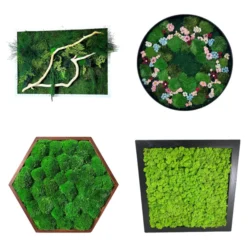
Showing 1–12 of 53 resultsSorted by popularity
Plant Wall Price Calculator
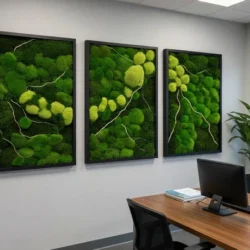
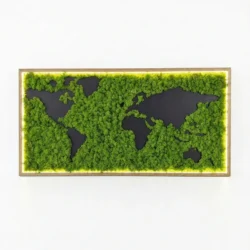
Original price was: 1.00 $.0.95 $Current price is: 0.95 $. Exc. TaxExclusive world map made of Icelandic moss with wooden continents & LED frame
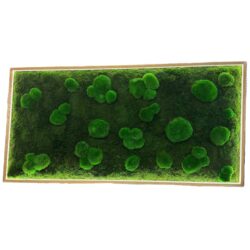
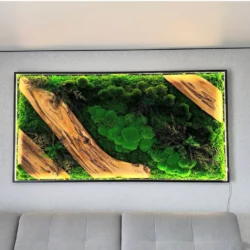
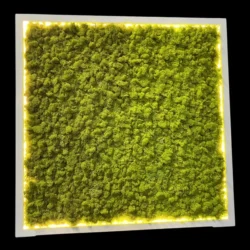
Price range: 403.20 $ through 2520.00 $ Exc. TaxLED Moss Picture – Mix of Ball Moss & Flat Moss
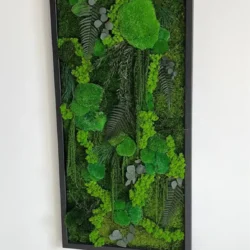
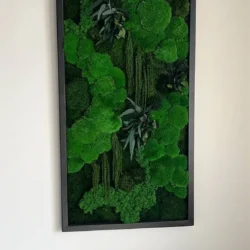
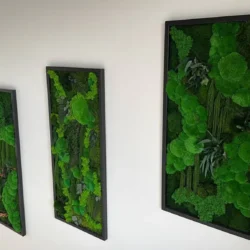
Price range: 403.20 $ through 2419.20 $ Exc. TaxMoss Picture “Jungle Cascade” – Plants Edition
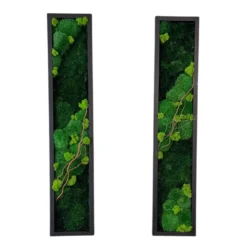
Price range: 259.20 $ through 2419.20 $ Exc. TaxMoss Art “Boulder Moss Jungle Cascade” – Plants Edition
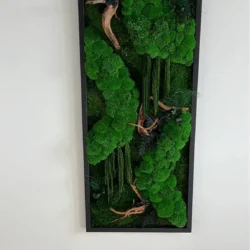
Price range: 259.20 $ through 2419.20 $ Exc. TaxMoss Picture “Ball Moss Jungle Cascade” – Driftwood Edition
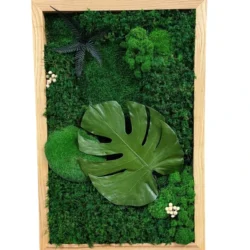
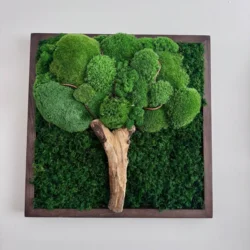
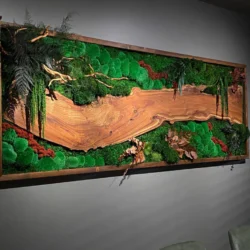
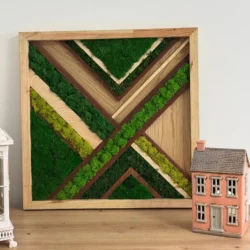
Price range: 259.20 $ through 2419.20 $ Exc. TaxMoss Wall Art with Wood – Walnut Forest Landscape
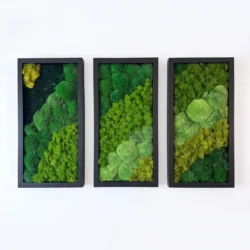
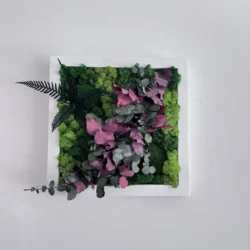
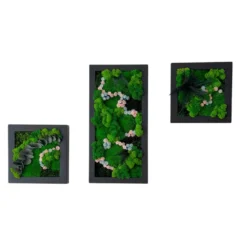
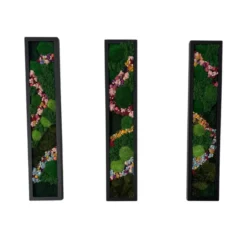
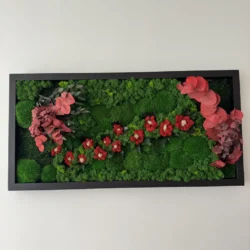
Price range: 316.80 $ through 3024.00 $ Exc. TaxWall Art Set: Floral Moss Trio with Frames
Price range: 288.00 $ through 2160.00 $ Exc. TaxRectangular moss wall art is the format most walls were designed for. Furniture is rectangular, rooms are rectangular, and a horizontal panel above a horizontal sofa agrees with everything around it — which is exactly why this is the largest section of our wall art and the one most people end up choosing.
Square and rectangular moss wall art behave differently despite sharing the corner geometry, so it is worth treating them as two decisions rather than one.
Horizontal Rectangular Moss Wall Art
A wide moss panel does one job better than any other shape: it fills the space above a piece of furniture without leaving awkward gaps at either end.
The proportion rule is the same as elsewhere — aim for roughly two-thirds the width of what sits beneath. Above a 200 cm sideboard that means something in the region of 130 cm, and the instinct to hang something 60 cm wide there is what makes so many living rooms look unfinished.
Panoramic formats go further, at ratios of 3:1 or wider. These are for specific situations: above a long low sideboard, along a corridor wall, behind a dining table. In an ordinary room they look stretched, and they need a genuinely long wall to make sense.
Square Moss Wall Art
Square moss wall art is the quieter option. Having no dominant direction, they do not pull the eye sideways the way a horizontal does, which makes them useful where a panel should be present without taking over.
They work best on narrow walls — a chimney breast, the section between two windows, the wall at the end of a hallway. They also cluster better than horizontals: four squares in a grid read as a deliberate composition, while four horizontals stacked up read as a filing system.
| Format | Proportion | Best position |
|---|---|---|
| Horizontal | Roughly 3:2 or 2:1 | Above sofas, beds, sideboards |
| Panoramic | 3:1 and wider | Long walls, corridors, behind dining tables |
| Square | 1:1 | Narrow walls, chimney breasts, grid clusters |
| Vertical | 2:3 and taller | Between doors and windows; beside tall furniture |
How Shape Changes the Composition
A circle draws attention to its centre; rectangular moss wall art does not. A rectangle does not — the eye enters at one edge and travels across, which means the material has to sustain interest along the whole length rather than at one point.
This is why our wide panels are usually built as landscapes: a denser, darker band along the lower edge, lighter material above, sometimes preserved plants or driftwood crossing the composition diagonally to give the eye a path. It reads as a scene rather than as a texture sample, and at 130 cm wide that difference matters.
Squares tolerate simpler treatment. A single species filled evenly across a square works because the shape itself is stable; the same treatment across a two-metre panorama would be monotonous by the halfway point.
Frames and Corners
Frames for rectangular moss wall art are solid oak and ash, cut and joined so the corners stay tight — with straight-sided formats, corner joints are the first thing to fail on cheap frames and the first thing anyone notices up close.
Depth matters as much as the outline. The frame has to hold the material without compressing it, which is why a panel frame is a deeper object than a picture frame of the same face dimensions. Frameless versions, with material worked to the edge of the backing, read as more contemporary and sit flatter to the wall.
Hanging a Rectangular Panel
- Centre the panel on the furniture below, not on the wall — the two are rarely the same point, and furniture wins.
- Leave 15–25 cm between the top of the furniture and the bottom of the panel. Much more and they stop reading as a pair.
- For wide panels, use two fixings rather than one. It spreads the load and, more usefully, stops the panel rotating out of level over time.
- Check with a spirit level. Unlike a circle, a rectangle shows every fraction of a degree.
Where Rectangular Moss Wall Art Works Best
For rectangular moss wall art the living room is the obvious case and the one people plan for. The wall above a sofa is usually the largest uninterrupted surface in a house, and it is the wall guests look at while sitting down, which is why it gets more attention than any other.
Bedrooms take horizontal panels above the headboard. Here the proportion rule bends slightly: matching the bed width exactly looks better than the two-thirds guide, because a headboard reads as a base rather than as furniture with space around it.
Dining rooms are where panoramic formats earn their keep. A long panel along the wall beside a table works at the eye level of seated people, which is lower than standing eye level — hang it 10 to 15 centimetres lower than you would in a hallway.
Offices and commercial interiors choose these formats almost by default, partly because they suit the architecture and partly because they are the easiest to specify in quantity. Ten identical horizontal panels along a corridor is a normal order; ten identical circles would look like signage.
One Large Piece or Several
On a wide wall the choice is between a single large panel and several smaller ones, and it is worth thinking about before ordering rather than after.
One large moss panel reads as architecture. It becomes part of the wall, and the room organises itself around it. Several smaller panels read as a collection, which suits informal rooms and gives you flexibility later — you can move one, add a fourth, or redistribute them when the furniture changes.
The failure mode is in between: two panels of similar size with an awkward gap, which reads as an unfinished attempt at a set. If you go with multiples, either butt them close together or space them at a clear, deliberate interval. See 3-piece sets for compositions designed together from the start.
Moss Panel Care and Lifespan
Indoors, 7 to 10 years. No watering, no light requirement, no feeding.
Keep panels out of direct sunlight and away from constant damp. Dust with a cool hairdryer on the lowest setting, working along the length rather than across it. Never vacuum a panel or wipe it with a cloth.
Rectangular Moss Wall Art: Frequently Asked Questions
Square or horizontal — how do I choose?
Look at what is beneath. Furniture wider than it is tall wants a horizontal panel. An empty narrow wall wants a square.
How wide should it be above my sofa?
About two-thirds the sofa width. Most people’s first instinct is roughly half that.
Can I hang two side by side?
Yes, if they match in height and the gap between them is smaller than either panel. Otherwise they read as two unrelated objects.
Do wide panels need two fixings?
Above roughly a metre, yes — mainly to stop them drifting out of level.
Can I order a custom size?
Yes. Send the wall dimensions and a photograph, and we will advise on proportion first.
Related Collections
For pieces beyond standard sizes, see large and XXL moss wall art. To cover a wide wall with several pieces instead of one, 3-piece sets. All formats are under moss wall art.