







Showing 1–12 of 39 resultsSorted by popularity
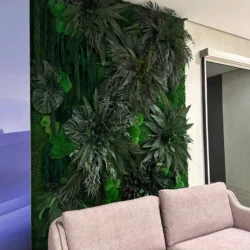
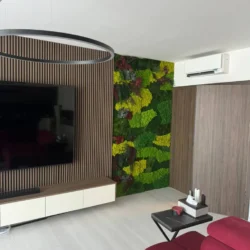
Plant Wall Price Calculator
Original price was: 1.00 $.0.95 $Current price is: 0.95 $. Exc. Tax

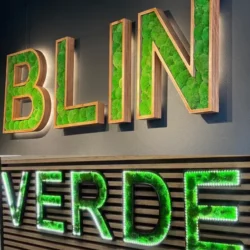
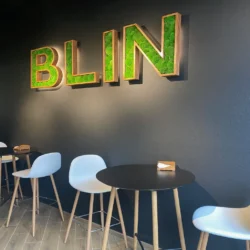
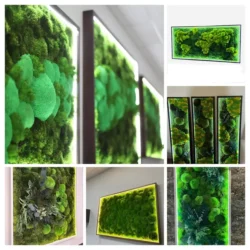
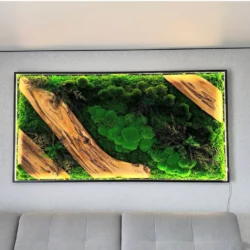
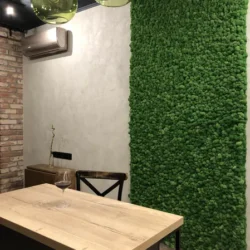
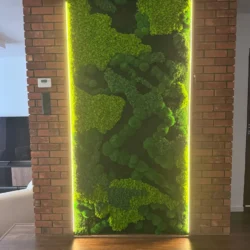
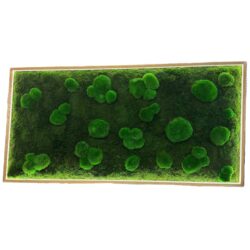
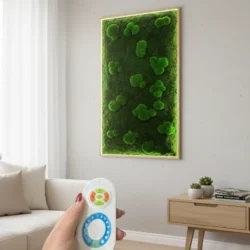
LED Moss Picture – Mix of Ball Moss & Flat Moss
Price range: 403.20 $ through 2419.20 $ Exc. Tax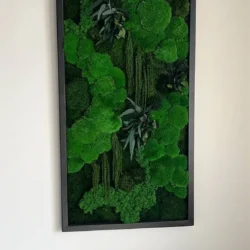
Moss Art “Boulder Moss Jungle Cascade” – Plants Edition
Price range: 259.20 $ through 2419.20 $ Exc. Tax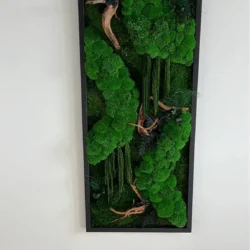
Moss Picture “Ball Moss Jungle Cascade” – Driftwood Edition
Price range: 259.20 $ through 2419.20 $ Exc. Tax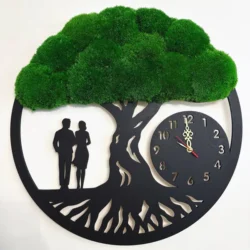
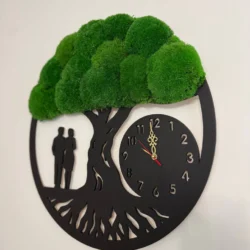
Moss Wall Clock Tree of Life with Couple
Price range: 126.40 $ through 606.40 $ Exc. Tax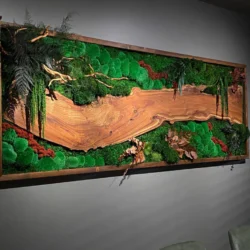
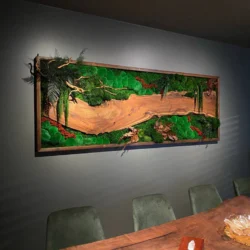
Moss Wall Art with Wood – Walnut Forest Landscape
Price range: 316.80 $ through 3024.00 $ Exc. Tax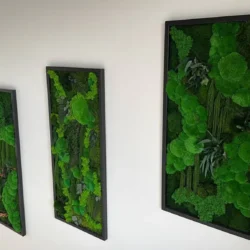
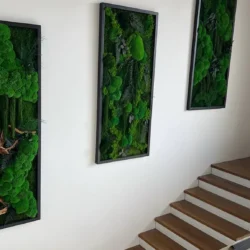
3-Piece Moss Picture Set: Jungle Cascade with Cushion Moss
Price range: 691.20 $ through 5760.00 $ Exc. Tax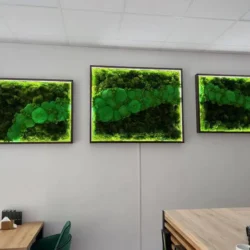
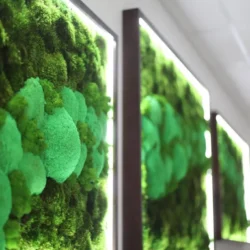
Moss Picture Set with Lighting
Price range: 907.20 $ through 3598.40 $ Exc. TaxBun moss grows in dense rounded mounds, which is why it is also sold as cushion moss, pillow moss and — confusingly — ball moss. Whatever the label, it is the material you want when a panel needs to look three-dimensional rather than flat.
Every other moss we work with covers a surface. This one builds on it. A panel filled with domed mounds has real relief: two or three centimetres of variation between the top of a mound and the valley beside it, and that difference is what creates shadow.
Why Bun Moss Wall Art Casts Shadow
A flat green surface under flat light is just a colour. Give it depth and it becomes an object that changes through the day — morning light from a window rakes across the mounds and throws shadow one way, an overhead lamp in the evening throws it another.
This is the practical reason people choose this material over the smoother alternatives. It photographs poorly in catalogue lighting, where everything is lit evenly to eliminate shadow, and it looks best in exactly the conditions catalogue photography avoids. If you have seen this material in a photograph and found it unremarkable, that is why.
The corollary: position matters more here than with any other species. A panel of this material on a wall lit only from directly in front loses most of what you paid for. Give it light from above or the side.
How We Use It in a Composition
We rarely use bun moss alone, and this is a deliberate choice rather than a cost decision. A whole panel of domes has no rest in it — every square centimetre competes for attention, and the eye finds nowhere to settle.
The compositions that work set mounds against something calmer:
- Against flat material — the classic combination. Low carpeting species as the ground, domes rising out of it, so the relief has something to measure itself against.
- With reindeer lichen — branching texture between the mounds fills the valleys without flattening them.
- With preserved plants — ferns and grasses laid across the surface, which emphasises the height difference by crossing it.
- In hexagons — one or two domed panels among smoother ones in a tiled arrangement. See hexagon pieces.
- In sets — where one piece carries the relief and the others stay quiet.
Bun Moss, Cushion Moss and Ball Moss
Worth clearing up, because it causes real confusion for American customers.
In the United States, “ball moss” most often refers to Tillandsia recurvata — an air plant that grows on tree branches across Texas, Florida and the Gulf states. It is not a moss, it is not what we sell, and for many homeowners it is a nuisance they pay to have removed from their oaks.
What we work with is a true moss, a mounded species in the Leucobryum family, harvested for decorative use and preserved. In the European decorative trade it is usually called bun or cushion moss. If you arrived here looking for something to put on a wall, you are in the right place. If you arrived looking for how to remove growth from a tree, you are not.
Depth, Frames and Weight
Frames for bun moss wall art need more depth than standard picture frames, because the mounds stand proud of the backing. A frame built for flat material will compress the domes against the glass line and flatten the effect entirely — which is the single most common way this material gets ruined by people building their own pieces.
Ours are made deep enough that the tallest mounds sit clear. The material weighs very little despite its bulk, so even large panels hang from ordinary fixings.
| Material | Relief | Best position |
|---|---|---|
| Bun / cushion | High — 2–3 cm of variation | Side or overhead light; walls you pass close to |
| Reindeer lichen | Medium, even | Any lighting; large uniform areas |
| Flat / sheet | Low | Backgrounds and flat planes |
Where Bun Moss Wall Art Works Best
Bun moss wall art belongs anywhere people pass close enough to notice it. This material rewards proximity in a way that flat surfaces do not — at half a metre you can see individual mounds and the shadow between them, and at four metres you see a green rectangle much like any other.
- Hallways and entryways — walls you walk past within arm’s reach every day.
- Beside a sofa or reading chair — seated eye level, close range, exactly where the relief reads.
- Reception desks — visitors stand close while waiting, with nothing else to look at.
- Home offices — behind you on video calls, where camera lighting from the front is the one condition that flattens it, so light it from the side.
- Restaurant walls beside banquettes — diners sit within reach for an hour or more.
Where it works less well: high stairwell walls, double-height lobbies, anywhere the nearest viewing position is several metres away. Those walls want scale and colour contrast rather than fine relief, and reindeer lichen or a mixed composition will serve them better for the same money.
Living With Bun Moss
People touch this material. It is the single most consistent thing we observe in showrooms and at trade fairs — visitors reach out without thinking, because a domed green surface reads as something that should feel soft, and it does.
That is worth planning for rather than fighting. If a panel goes somewhere the public can reach it, expect it to be touched and accept the wear, or hang it above hand height. In a home it matters less; occasional contact does no real damage, and the mounds recover from light pressure. What they do not recover from is sustained compression — a panel leaned face-first against a wall for a month comes back flattened.
Care and Lifespan
Indoors, 7 to 10 years. No watering, no light needed, no feeding.
One point specific to this material: do not press on the mounds. Preserved domes are resilient but not infinitely so, and a mound crushed flat by a hand or by packaging pressure does not fully recover its shape. Handle panels by the frame, and if a piece has been boxed for a long period, give it a day to recover loft before judging it.
Keep it out of direct sun and away from damp. Dust with a cool hairdryer on the lowest setting, held back far enough that the airflow does not push into the valleys between mounds.
Bun Moss Wall Art: Frequently Asked Questions
Is bun moss the same as cushion moss?
Yes. Bun, cushion and pillow are all trade names for the same mounded material.
Is it the same as the ball moss on trees in Texas?
No. That is Tillandsia recurvata, an air plant and not a moss at all. Different organism entirely.
How much depth does a panel have?
Two to three centimetres of variation between the top of a mound and the surface beside it, which is what produces the shadow.
Will the mounds flatten over time?
Not on their own. They flatten under pressure, so avoid pressing on them and avoid tight packaging in storage.
Does it need special lighting?
Not special, but directional. Light from above or the side shows the relief; flat frontal light hides it.
Can I combine it with other species in one custom piece?
Yes, and we usually recommend it. Domes alone leave the eye nowhere to rest.
Related Collections
For springy branching texture instead of domes, see reindeer and Iceland lichen pieces. All shapes and formats are under moss wall art, and the loose material by the box is in preserved moss.