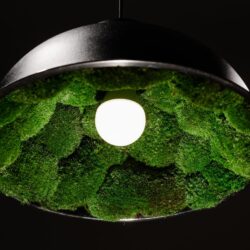
Acoustic and Botanical Architecture in Moss Pendant Lights
Suspended illumination transforms open ceilings by introducing biological textures directly into functional task lighting. Moss pendant lights combine powder-coated steel or aluminum fixtures with preserved greenery, creating a dual-purpose installation that balances downward lumen output with passive acoustic damping. In commercial offices, restaurants, and residential dining areas, high ceilings often generate reverberant flutter echoes. By wrapping or filling the exterior shade surfaces with preserved moss, these overhead fixtures trap high-frequency sound waves right at ear level.
Every fixture uses natural vegetation preserved through a non-hazardous glycerin substitution process. The biological fluids inside the plant cells are fully replaced, which arrests cellular decay and seals the cellular structure permanently. This keeps the moss soft to the touch without needing water, soil, drainage plumbing, or horticultural grow lamps. Standard electrical drops connect directly to ceiling junction boxes, suspending the weight securely with reinforced steel aircraft cables.
Preserved Moss Varieties and Structural Specifications
Light fixtures within this collection incorporate three distinct preserved bryophyte species depending on the desired light diffusion and surface density. Ball moss (cushion moss or pole moss) provides high three-dimensional relief, creating defined mounds that cast natural shadows across the fixture housing. Flat moss (sheet moss) functions as an even, low-profile base layer that tightly hugs circular and cylindrical profiles. Reindeer moss (Iceland moss) adds branched, coral-like textures that absorb ambient sound across large conference tables or open-plan workbenches.
Moss Type
Texture Profile
Average Depth (cm / in)
Primary Acoustic Application
Ball Moss (Cushion Moss)
Dense, convex mounds
5–8 cm / 2.0–3.1 in
Mid-frequency sound diffraction
Flat Moss (Sheet Moss)
Smooth, fibrous matting
1–2 cm / 0.4–0.8 in
Fixture contouring and base coverage
Reindeer Moss (Iceland Moss)
Spongy, multibranched
4–6 cm / 1.6–2.4 in
High-frequency noise dampening
The integrated metal chassis protects internal electrical components from biological material. Luminaire bases are engineered with integrated heat sinks that direct thermal energy away from the preserved moss layer, preventing premature drying of the plant matter. Standard installations accommodate standard E26 screw bases or integrated LED driver arrays calibrated for warm white color temperatures between 2700K and 3500K.
Environmental Guidelines and Maintenance Parameters
Preserved vegetation requires specific interior atmospheric parameters to maintain tactile flexibility over years of service. Unlike living plants, preserved fixtures must never be misted, watered, or placed in direct contact with HVAC supply vents. Air currents from mechanical ventilation blow dry air across the moss surface, which draws out residual glycerin and causes brittleness.
Maintain ambient indoor relative humidity between 40% and 65% to keep plant fibers pliable.
Avoid direct sunlight exposure to prevent UV degradation of the natural mineral pigments.
Keep minimum clearances of 30 cm / 12 in between the moss surface and high-output heat sources.
Dust every six to twelve months using a dry microstatic duster or compressed air at low pressure.
Free shipping within 10–30 business days applies to all fixture sizes across the contiguous United States.
These ceiling-mounted fixtures operate entirely maintenance-free when kept within recommended interior settings. Suspension heights adjust via tool-free clutch mechanisms integrated into the ceiling canopy, letting installers align multiple units across conference tables, kitchen islands, and hotel reception desks.