Natural Coconut Shell Accents with Ball Moss and Provence Moss
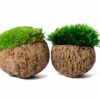
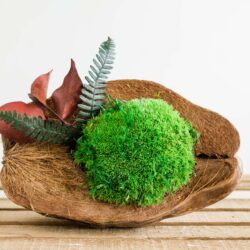
This botanical tabletop set pairs organic coconut shells with two distinct preserved moss varieties. Each coconut half serves as a rigid, textured base for either ball moss (cushion moss or pole moss) or provence moss (mood moss). Measuring approximately 10 cm x 5 cm (3.9 in x 2.0 in), these compact natural accents introduce contrasting organic textures to desks, shelving units, credenzas, and side tables without requiring floor space or dedicated plant stands.
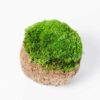
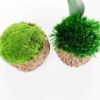
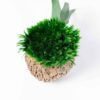
The coconut hulls retain their rough, fibrous exterior bark and deep earth tones, contrasting with the dense foliage resting above the rim. One piece features the mounded, tight growth habit of ball moss, while the companion piece showcases the longer, wavy tendrils characteristic of provence moss. Because both elements undergo an preservation process using a plant-safe saline and glycerin solution, the greenery maintains its tactile softness, structural volume, and green coloration over several years without water or sunlight.
Technical Specifications and Physical Characteristics
Each set consists of two prepared half-shells sourced from real coconuts, cleaned and stabilized for indoor display. Minor variances in diameter, wall thickness, and surface fissures are natural characteristics of dried coconut timber.
| Specification |
Detail |
| Product Contents |
Set of 2 decorative coconut halves (1 ball moss, 1 provence moss) |
| Dimensions per Unit |
Approx. 10 cm diameter x 5 cm height (3.9 in x 2.0 in) |
| Foliage Types |
Preserved ball moss (pole moss) and provence moss (mood moss) |
| Base Material |
Cleaned, dried natural coconut shell |
| Shipping Timeline |
Free shipping within 10–30 business days. |
Placement Guidelines and Environmental Requirements
Preserved botanical displays do not function like living potted houseplants. The stabilization process halts biological cell division, which eliminates biological needs such as watering, soil fertilizing, and pruning. Dust accumulation can be managed with a light blast of compressed air or a soft-bristled brush applied every few months.
Position the arrangements away from HVAC return registers, forced-air heating ducts, and dehumidifiers to protect the internal glycerin reserve from desiccation. Constant exposure to unfiltered sunlight through window panes will degrade natural plant chlorophyll and cause premature discoloration.
- Target humidity: Maintain ambient indoor relative humidity between 40% and 60% to preserve leaf flexibility.
- Temperature range: Suitable for rooms stabilized between 68 °F and 77 °F (20 °C to 25 °C).
- Moisture restriction: Never mist, submerge, or pour liquid onto the moss or shell.
- Light exposure: Keep in shaded, indirect light or windowless rooms under artificial light fixtures.






Reviews
There are no reviews yet.